Why New Hiking Boots Still Hurt After You 'Broke Them In' — the Real Fix
Quick Answer: If boots still hurt after a proper break-in, the leather has softened but the internal fit hasn’t changed — the pain is almost always a pressure point, not a size problem. Heat-mold the spot or swap insoles before you swap boots.
You did the 20-mile break-in plan. Short walks first, thick socks, no big trips until week three. And your left heel still screams by mile four. That’s not a discipline failure — it’s a fit-mapping problem the standard break-in advice never addresses.

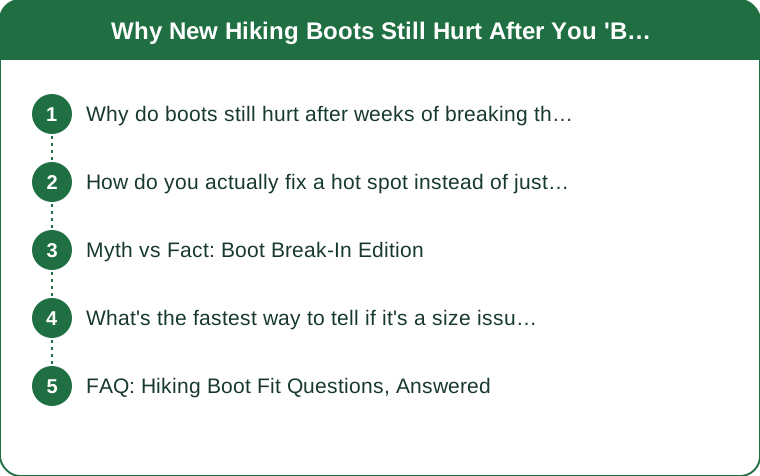
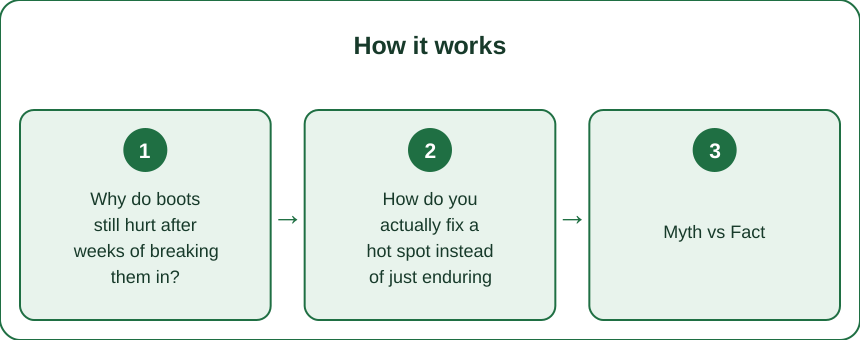
Why do boots still hurt after weeks of breaking them in?
Because break-in softens the leather, not the internal shape around your foot. If your foot has a bony prominence — a high instep, a wide fifth metatarsal — the boot’s shell stays the same shape no matter how many miles you log.
The pain you feel at mile four isn’t randomness. It’s the same 1-2 contact points every time, which is the clue: this is a spot problem, not a whole-boot problem.
How do you actually fix a hot spot instead of just enduring it?
Heat-mold the specific panel. A hair dryer on the outside of the trouble spot for 60-90 seconds, then wear the boots around the house for 20 minutes while the leather is warm, molds it to your exact foot.
If that doesn’t fully solve it, change the insole before the boot. A third of fit complaints resolve with a $20-40 aftermarket insole that changes heel cup depth or arch contact — cheaper and faster than a new pair.

Myth vs Fact: Boot Break-In Edition
Myth: More miles always finishes the break-in. Fact: Leather stops softening measurably after about 15-25 miles. Pain past that point is a fit issue, not a patience issue.
Myth: Thick socks fix a boot that’s too small. Fact: Thick socks reduce room, not add it — if boots feel tight, a thinner technical sock plus the correct size solves more than sock thickness ever will.
Myth: Pain means you need a bigger size. Fact: Going up a size often creates heel slip, which causes blisters that mimic the exact pain of boots being too small. Check width before length.
What’s the fastest way to tell if it’s a size issue or a spot issue?
Do the thumb test and the heel-lift test back to back:
- Thumb test: unlaced, foot slid forward until toes touch the front — a thumb’s width of space behind the heel means length is right.
- Heel-lift test: laced up, walk downhill on a ramp or stairs. More than about 1/4 inch of heel lift means width or lacing, not length, is the problem.
If both pass and pain persists, it’s 100% a localized pressure point — go straight to heat-molding.
FAQ: Hiking Boot Fit Questions, Answered
How long should hiking boots take to break in?
Most leather boots need 15-25 miles of mixed terrain. Full-grain leather takes longer than synthetic-leather hybrids — budget 2-3 weeks of regular wear before a big trip.
Can a shoe repair shop stretch hiking boots?
Yes — a cobbler with a boot stretcher can widen a specific panel by about a quarter size in 24-48 hours, which is often faster and cheaper than returning boots for a new size.
Should hiking boots feel tight when new?
Snug through the midfoot with room to wiggle toes, yes. Sharp pain at a single point on day one usually predicts the same spot hurting at mile 10 — don’t wait it out.
TL;DR:
- Persistent pain after proper break-in is usually one pressure point, not a wrong size
- Heat-mold the exact spot with a hair dryer, then walk it in warm
- Try a $20-40 insole swap before buying new boots
- Run the thumb test + heel-lift test to rule out true sizing issues first
Find the spot, fix the spot — most boots people give up on had one solvable problem, not a fundamentally wrong fit.
Keep Reading
This article is for general informational and styling purposes only. Fit, sizing, and product availability may vary.