7 Boot Problems That Only Appear Once the Trail Gets Wet
Quick Answer: Wet conditions expose problems that dry ground hides: worn lugs lose grip on wet rock, waterproof membranes fail at flex points, wet socks change the fit, and leaves conceal the surface entirely. Most of these are maintenance and fit issues that were present all summer and simply had no consequence until the ground changed.
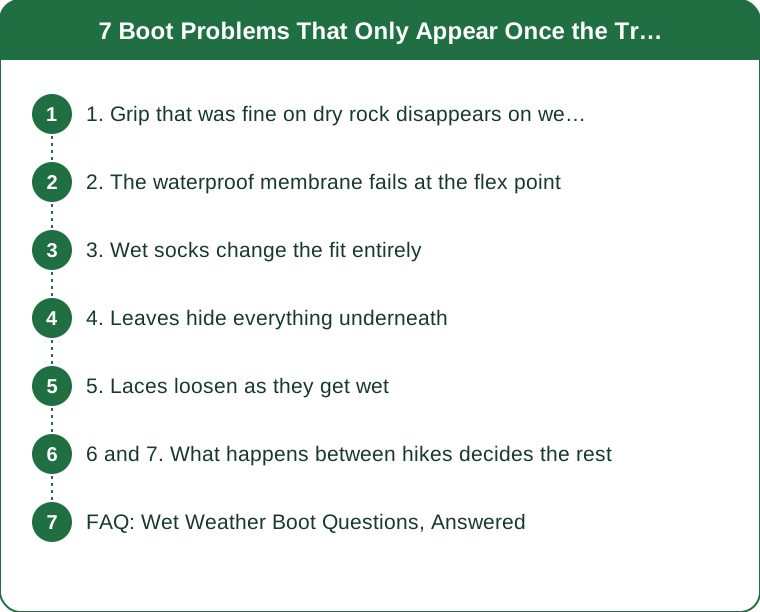
Seven problems, and what to do about each before the first wet hike rather than during it.
This is general information, not medical advice.

1. Grip that was fine on dry rock disappears on wet rock
Lug depth matters far more when wet. Worn lugs still bite on dry trail and lose almost all purchase on wet rock and packed mud.
Check the heel edge first. Grip failure on descents usually starts at the outer heel, which wears fastest and is the contact point that stops you sliding.
Rubber compound matters as much as tread pattern. Softer compounds grip wet rock better and wear faster; harder compounds last longer and slip more. Neither is wrong, but knowing which you have tells you what to expect.
The test: if you can no longer feel distinct lug edges with your thumb across the heel and forefoot, the boot is done for wet season regardless of how the upper looks.
2. The waterproof membrane fails at the flex point
Membranes fail where the boot bends, across the forefoot, long before they fail anywhere else. Repeated flexing degrades the laminate over hundreds of kilometres.
Wetting out is not the same as leaking. When the outer fabric saturates, the boot feels wet and cold and breathability collapses, even though water is not entering. Reproofing the outer fixes this; nothing fixes a genuinely failed membrane.
Test it before you need it. Fill a sink and stand in it for two minutes, or walk a wet field. Better to find out in the garden.
Reproof at the start of the wet season, not in the middle. A clean, dry boot takes treatment far better than a muddy one.
3. Wet socks change the fit entirely
Damp socks compress and lose loft, so a boot that fitted with dry socks develops heel lift once they are wet.
Wet feet also swell, which pushes in the opposite direction and can make the toe box tight while the heel is loose.
This is the main cause of autumn blisters in boots that caused none all summer.
The fix is a sock system, not a thicker sock. A thin liner under a wool sock manages both moisture and friction, and changing socks at the halfway point of a long wet day is the single most effective blister prevention there is.
4. Leaves hide everything underneath
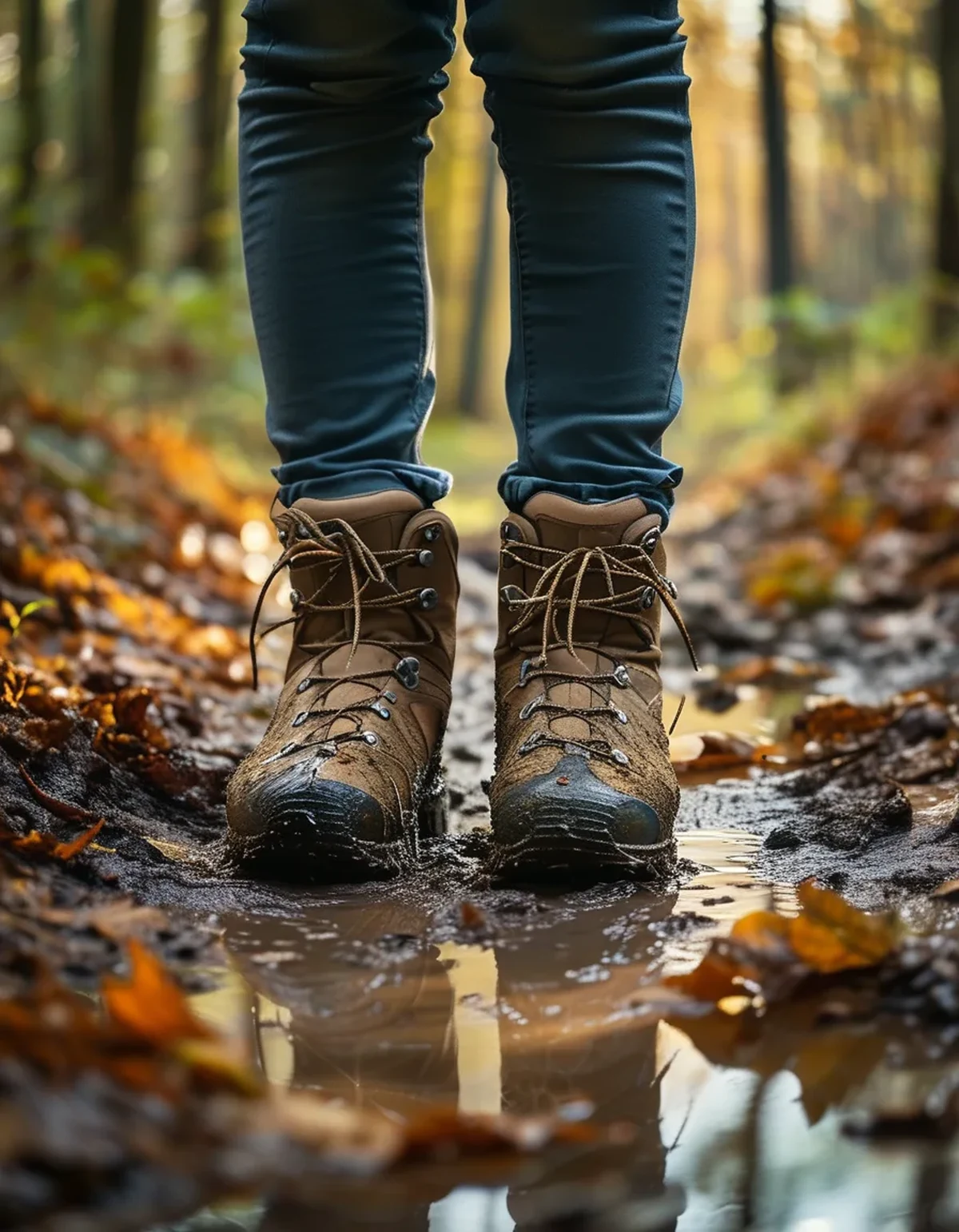
Leaf cover conceals roots, rocks, holes and ice, and it is slippery in its own right when wet.
Ankle support matters more in this specific condition than in almost any other, because the failure mode is a foot landing on an unseen uneven surface at speed.
Shorten your stride on leaf-covered descents. More, smaller steps means less force through each landing and more chance to correct.
Poles genuinely help here and are worth carrying in autumn even if you skip them in summer.
5. Laces loosen as they get wet
Wet laces stretch and slip, particularly synthetic round laces, and a boot that was secure at the trailhead can be noticeably loose an hour in.
Heel lift from loosened laces is the direct cause of the black toenails and heel blisters people blame on the boot.
Retie at the first stop, every time. It takes 30 seconds and it prevents most wet-weather foot damage.
Use a surgeon’s knot at the ankle lock to hold tension across the instep independently of the lower lacing. This one technique solves the majority of heel-lift complaints.
6 and 7. What happens between hikes decides the rest
6. Boots dry wrong and get damaged doing it
Direct heat destroys boots. Radiators, open fires, hot air vents and car heaters all ruin adhesives and crack leather, and it happens considerably faster than people expect — a single night against a radiator can do visible damage to a midsole bond.
Newspaper, room temperature, laces out, insoles out. It takes 24 to 48 hours and it is the only method that does not shorten the boot’s life. Changing the newspaper after the first few hours roughly halves the total time.
Two pairs solve the drying problem entirely if you hike frequently in wet conditions, because a 48-hour dry does not fit into a weekly schedule otherwise. Rotating pairs also extends the life of both, since foam midsoles recover between uses.
Never store them damp. A damp boot in a cupboard grows mould in the lining and degrades the membrane from the inside, and this is where most off-season boot deaths actually happen — not on the trail, but in a dark cupboard in November.
7. The insole is finished before the boot is
Insoles compress and stop supporting long before the outsole wears out, and wet conditions accelerate it as they absorb and release moisture repeatedly through a season.
A flattened insole changes the fit by adding volume inside the boot, producing heel lift and toe-box slop that feel exactly like a boot that has stretched. People replace perfectly good boots over this.
Replacing the insole is cheap and frequently makes a boot that had been written off feel close to new. It is the first thing to try on any boot that has become subtly uncomfortable without any visible change.
Take them out after every wet hike regardless, both to dry the boot properly and to check their condition. An insole that stays compressed when you press it, or that has gone dark and stiff at the heel, is finished.
If arch pain or new hotspots appear in a boot that used to be comfortable, check the insole before concluding the boot has failed. In wet-season use this is the single most common cause of a boot that suddenly stopped working.
FAQ: Wet Weather Boot Questions, Answered
Are waterproof boots always better in autumn?
Not always. Waterproof membranes keep water out and also keep sweat in, and in prolonged wet conditions where water enters over the cuff anyway, non-waterproof boots that drain and dry fast are sometimes the better choice.
How often should I reproof?
When water stops beading on the outer surface. For regular autumn use, that is typically once or twice a season.
Can I speed up drying safely?
A fan at room temperature is safe and roughly halves the time. Boot dryers designed for the purpose are also fine. Direct heat is not.
TL;DR:
- Worn lugs and hard compounds fail on wet rock long before they look worn out.
- Membranes fail at the forefoot flex point; wetting out is a reproofing problem, not a leak.
- Wet socks cause heel lift and swelling at once — use a liner system and change socks mid-day.
- Retie laces at the first stop, with a surgeon’s knot at the ankle lock.
- Dry at room temperature with insoles out, and replace flattened insoles before replacing boots.
Wet season does not break boots. It reveals what was already wrong with them.
This is general information, not medical advice.
Keep Reading
This article is for general informational and styling purposes only. Fit, sizing, and product availability may vary.