7 Boot Fit Problems and What Each One Is Actually Telling You
Quick Answer: Most boot problems are location-specific and each location points to a different cause. Heel lift is usually lacing or heel-pocket volume; toe bang is length or descent lacing; numbness is width or instep pressure; arch ache is footbed support. Very few of them mean the boot is simply the wrong size.
Boots that hurt get replaced with boots that hurt somewhere else. The pattern repeats because the symptom gets treated as a size problem when it is almost always a shape, volume, or lacing problem.
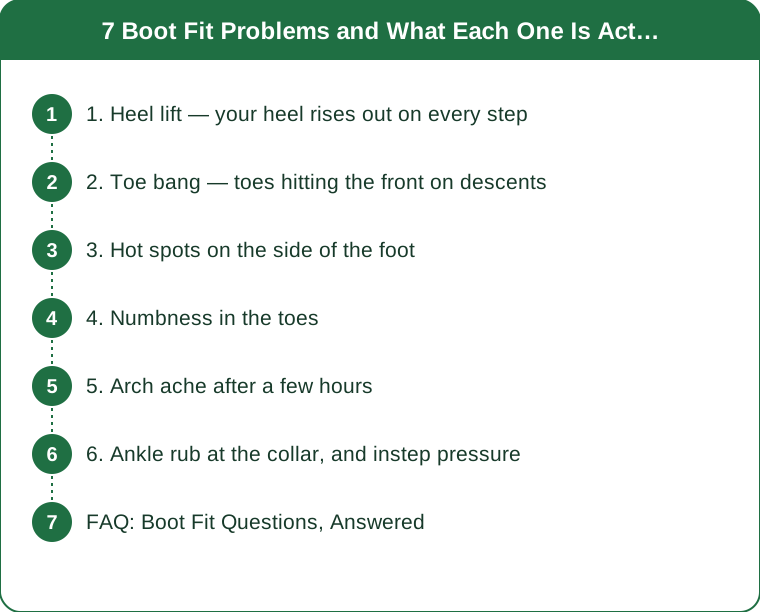
Here are the seven most common complaints and what each specifically indicates.

1. Heel lift — your heel rises out on every step
What it means: the heel pocket is too voluminous for your heel, or your lacing is not locking the foot back into it.
Heel lift is the most common single complaint and the most common cause of blisters, because it produces repeated friction at the back of the heel and the Achilles.
Fix it in this order. First, try a heel-lock or surgeon’s knot lacing: at the ankle flex point, tie a locking knot to separate the lower and upper lacing zones, then lace the ankle firmly while keeping the forefoot comfortable. This alone resolves a large share of cases.
Second, add a thin volume-reducing insole or a heel grip pad. Third, try a thicker sock — one full weight heavier can take up a few millimetres of volume.
When it is genuinely the boot: if a locked lace and a thicker sock still allow visible movement, your heel is narrower than the last was designed for and no adjustment will fix it. Brands vary substantially in heel width, and this is the single most useful thing to know when boot shopping.
2. Toe bang — toes hitting the front on descents
What it means: either the boot is too short for downhill use, or your foot is sliding forward because the upper lacing is not holding it back.
Feet swell during a hike, and on descents the whole foot shifts forward with every step. A boot that fits perfectly on flat ground can be a half size too short for a long descent, which is why boot fitters recommend about a thumb’s width of space at the toe.
Fix it: lace tighter over the instep specifically, using the heel-lock knot again to keep the foot back. Check that you are not lacing evenly from bottom to top — the instep zone does the holding.
If your toenails go black or bruise, that is not something to accept as part of hiking. It means the foot travelled far enough to load the nail bed repeatedly, and it eventually costs you the nail.
When it is the boot: if space at the toe is less than a thumb’s width when standing, size up. Note that half sizes exist for exactly this and that many people wear a hiking boot a half to a full size larger than their street shoe.
3. Hot spots on the side of the foot
What it means: width mismatch, or a sock that is bunching.
A hot spot is friction before it becomes a blister, and it is the last easily reversible stage. Hot spots on the outer edge of the forefoot or over the fifth toe joint almost always indicate a boot narrower than your foot at the widest point.
Fix it immediately, on the trail. Stop as soon as you feel it — not at the next break. Tape the area with a smooth surgical tape or a blister patch before a blister forms. Adjusting lacing to reduce pressure over that zone can also relieve it.
Longer term: wide-fit versions exist across most major brands and are far more available than they used to be. Also check the sock — seams sitting over the toe joints, or a sock that has lost its elasticity and wrinkles, cause hot spots in a boot that fits perfectly.
Diagnostic tip: stand on the removed insole. If your foot overhangs it at the widest point, the boot is too narrow, full stop.
4. Numbness in the toes
What it means: compression across the instep or forefoot restricting nerve and blood supply — usually lacing, sometimes volume.
Numbness is different from pain and it should be taken more seriously, because it indicates something is being compressed rather than rubbed.
Fix it: loosen the lacing across the instep first, and consider a window lacing pattern that skips the eyelets directly over the pressure point. Many people lace tight across the top of the foot because it feels secure, and it is the most common cause of numb toes.
If loosening does not help, look at volume: a high-instep foot in a low-volume boot has nowhere for the tissue to go regardless of lacing.
When to be concerned: numbness that persists for hours after removing the boots, or that comes with tingling, weakness, or burning, may indicate a nerve issue such as Morton’s neuroma rather than a fit issue. That is worth a podiatry appointment rather than a lacing change. This is general information, not medical advice.
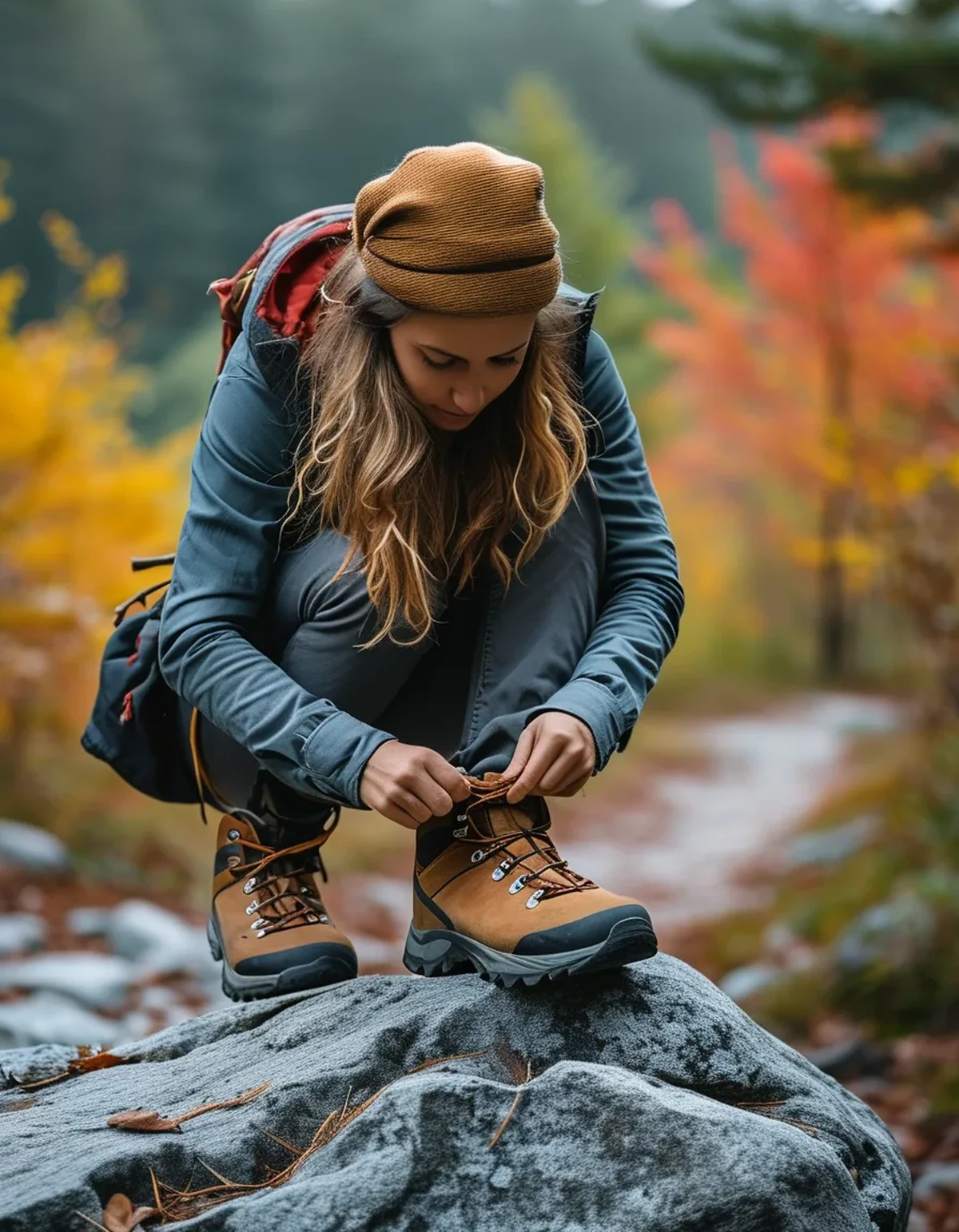
5. Arch ache after a few hours
What it means: the footbed is not supporting your arch shape, or the boot’s flex point does not match where your foot bends.
Stock insoles in most boots are thin, flat, and essentially placeholders. For anyone with a high arch or a low one, they provide almost nothing, and the plantar fascia takes the load instead.
Fix it: an aftermarket insole matched to your arch height is the highest-value upgrade available for hiking boots, and it costs a fraction of new boots. Get the arch height right rather than buying the most supportive option — an aggressive arch support under a low arch causes its own problems.
Also check flex point. Bend the boot by hand. It should crease at the ball of the foot, matching where your foot bends. A boot that flexes too far back forces your foot to work against the sole with every stride, and arch fatigue follows.
When it persists: arch pain that is worst in the first steps of the morning is a classic plantar fasciitis pattern and needs treatment rather than a new insole.
6. Ankle rub at the collar, and instep pressure
What it means: collar height or shape mismatched to your ankle, often combined with heel lift.
A boot collar that sits exactly at the point where your ankle bone protrudes, or that is stiff and unbroken-in, will rub. If your heel is also lifting, the collar is moving against the ankle with every step and the rubbing multiplies.
Fix it: solve heel lift first — it is very often the actual cause. Then look at sock height: a sock that ends below the boot collar guarantees skin-on-boot contact, and a taller sock is a five-minute fix.
Lacing the top eyelet more loosely, or skipping it entirely on flat terrain, reduces collar pressure while keeping the lower lacing secure.
Break-in reality check: modern boots with synthetic uppers need very little break-in and should be comfortable from the first walk. Full leather boots genuinely do need 30 to 50 km. If a synthetic boot needs breaking in, it does not fit — that is the most useful single sentence in boot fitting.
7. Pressure across the top of the foot
What it means: high instep volume, or lacing tension concentrated on a small area.
The instep is where the boot’s structure meets the most variable part of the foot, and instep height varies as much between people as width does — but almost nobody knows their own.
Fix it: use window lacing to bypass the pressure point, spreading tension above and below it. Swap round laces for flat ones, which distribute pressure over a wider contact area. Check whether the tongue padding has compressed unevenly or shifted sideways, which is common and easy to miss.
When it is the boot: low-volume boots exist specifically for low insteps, and high-volume ones for high. If you have persistently had instep pressure across multiple brands, you likely have a high instep and should be shopping that way rather than by size.
Fitting checklist for next time
Shop in the afternoon when feet are swollen, wear your hiking socks, stand on the removed insole to check width and length, walk a descent ramp in the shop, and expect to spend 45 minutes rather than 10.
FAQ: Boot Fit Questions, Answered
How much room should there be at the toe?
About a thumb’s width — roughly 1 to 1.5 cm — between your longest toe and the front when standing with the boot laced. Test by sliding your foot fully forward with laces undone; you should get a finger behind the heel.
Can two pairs of socks help or does it cause blisters?
A thin liner sock under a hiking sock genuinely reduces blisters for many people, because friction happens between the two sock layers rather than between sock and skin. Two thick socks, by contrast, usually create pressure and make things worse.
Are my boots the problem or my feet?
If a specific complaint follows you across three or more different boots, it is a foot characteristic — width, instep, arch, or heel shape — and the answer is shopping for that characteristic rather than trying more boots at random. If the problem is new with one pair, it is that pair.
TL;DR:
- Heel lift → heel-lock lacing, thicker sock, or a narrower heel pocket.
- Toe bang → more toe room and instep lacing that holds the foot back.
- Hot spots → width mismatch; tape at the first sensation, never later.
- Numbness → instep compression; loosen and use window lacing.
- Arch ache → aftermarket insole matched to your arch height, and check the flex point.
- Synthetic boots that need breaking in do not fit.
Almost every one of these is a lacing pattern or a five-pound insole away from solved, which is worth knowing before buying a fourth pair of boots.
Keep Reading
This article is for general informational and styling purposes only. Fit, sizing, and product availability may vary.