7 Hiking Boot Problems That Only Appear on Leaf Covered Trails
Quick Answer: Leaf litter is the most underrated hazard of the autumn trail season because it removes your ability to read the ground while simultaneously reducing traction to near zero on wet leaves over rock. The boot problems it exposes are mostly ones that existed all summer and were being compensated for by clear ground: a worn heel brake, an over-stiff sole, poor lacing at the ankle, and a lug pattern that packs rather than sheds. Wet leaves also hold water against the upper for hours, which finds every gap in your waterproofing. Most of the fixes are lacing and sock changes, not new boots.
The trail you walked all summer becomes a different trail in the second week of leaf fall. Everything underfoot is hidden, and the surface has changed from grippy to genuinely slick.
Seven specific problems show up, and only one of them requires buying anything.

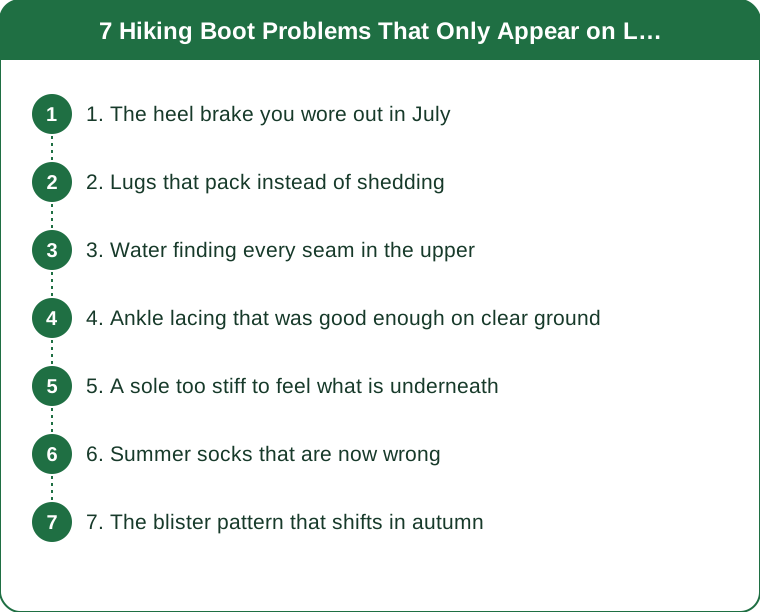
1. The heel brake you wore out in July
Descending on leaves is where a worn heel first becomes dangerous rather than merely inefficient.
Most hiking boot outsoles have a distinct heel brake - the pronounced edge at the rear of the heel that bites into the ground on descent. It is the single most important traction feature for going downhill, and it wears faster than the rest of the outsole because it takes concentrated force on every downhill step.
On clear ground, a rounded heel brake is survivable. On wet leaves it is not, because leaf litter over hardpack behaves like a layer of loose bearings and the heel edge is what would otherwise cut through to the ground beneath.
Check it directly. Look at the rear outer edge of the heel. If the sharp corner has rounded off into a curve, the brake is gone, regardless of how much lug depth remains elsewhere.
This is the one item on the list that means new boots - or a resole, if the boot is a resoleable construction. Heel brakes cannot be restored on a cemented sole.
Interim mitigation: shorten your stride markedly on descents and land more flat-footed rather than heel-first. It is slower and more tiring, and it is much safer than continuing to trust an edge that no longer exists.
2. Lugs that pack instead of shedding
Some outsole patterns clear mud well and clog with leaf matter, and the difference only shows in autumn.
Lug geometry is a compromise. Widely spaced, deep lugs shed soft mud effectively because there is room for material to be squeezed out as the sole flexes. Densely packed or shallow-siped patterns hold fine material - which is fine on rock and terrible under wet leaf mulch.
When the gaps between lugs pack with decomposing leaf matter, the outsole effectively becomes a flat plate. You lose all edge biting and you are relying on rubber friction alone against a surface that has almost none.
The tell is visual and immediate: stop after fifteen minutes on leafy trail and look at the sole. If the gaps are full, they will stay full.
The fixes are behavioral. Knock the soles against a rock or a log periodically - once every ten minutes on badly leafed sections is not excessive. Trekking poles help disproportionately here, because they let you offload some of the traction demand entirely.
And route selection matters. On a packed-out sole, favor the edges of the trail where leaf depth is lower, and step on exposed roots and rocks deliberately - counterintuitively, a clean rock is far more grip than a leaf-covered flat.
3. Water finding every seam in the upper
Leaf litter holds water against the boot for the entire hike in a way grass and mud do not.
Wet grass wets the boot and then the boot dries between wet sections. Deep leaf litter is a saturated sponge, and walking through it holds standing water in continuous contact with the upper - often above the level of the waterproof membrane’s practical protection, and always for far longer than a puddle crossing.
That sustained contact finds three things: degraded DWR treatment on the outer fabric, the seam where the upper meets the sole, and the tongue gusset.
The DWR is the fixable one and the one most people neglect. Durable water repellent coating wears off over a summer of use and washing, and when it fails the outer fabric wets out - which makes the boot heavier, colder and slower to dry even though the membrane underneath is still intact. Reproofing is a twenty minute job at the start of autumn and it makes a substantial difference.
Clean the boots first. DWR does not bond to dirty fabric, and reproofing over a summer’s accumulated grime is wasted effort.
The rand seam and tongue gusset are checks rather than fixes. Look for separation at the sole-to-upper join and for a tongue gusset that has torn at the top of its stitching. Both are repairable by a cobbler and both let water in exactly where leaf litter delivers it.

4. Ankle lacing that was good enough on clear ground
Hidden terrain means unplanned foot placements, and unplanned placements are where ankle lacing earns its keep.
On a clear trail you see the rock and place your foot deliberately. Under leaves, you find out where the rock is by standing on it. The rate of unexpected lateral foot placements goes up enormously, and that is precisely the load case ankle support is for.
Most people lace the same way all year. The autumn adjustment is to lock the ankle more firmly while keeping the forefoot relatively loose, which is achieved with a heel lock - the surgeon’s knot or lace lock at the ankle flex point.
The technique: lace normally to the top of the foot, then take a full extra wrap of the lace around itself at the ankle hooks before continuing. This creates a friction point that stops tension migrating between the forefoot and the ankle, so you can have a snug ankle and a comfortable toe box at the same time.
A firm ankle also prevents heel lift, which on descents through leaf litter is what causes both blisters and the loss of precise foot control.
Re-lace mid-hike. Laces loosen, and the point at which they matter most is the descent at the end when you are tired. Two minutes at the top of the descent is the highest-value stop of the day.
5. A sole too stiff to feel what is underneath
Stiffness that was an advantage on rocky summer scree becomes a liability when you cannot see the ground.
A stiff shank transmits less information from the ground to your foot. On visible terrain that is fine - you are using your eyes. Under leaf cover, proprioceptive feedback through the sole becomes your primary source of information about what you are standing on, and a very stiff boot filters most of it out.
The practical consequence is that you find out you are on an off-camber root a fraction of a second later than you would in a softer boot, and that fraction is the difference between an adjustment and a slip.
This is not an argument for abandoning stiff boots - if you are carrying weight or on genuinely technical ground, the stiffness is doing an important job. It is an argument for adjusting expectations and speed.
If you own both a stiff backpacking boot and a lighter mid, autumn day hiking on leafy trail is the season for the lighter one. The load is lower and the feedback matters more.
If you only own the stiff pair: shorten stride, slow down on descents, and use poles. Poles substitute directly for the ground feel you are missing, because they let you probe the surface before committing weight.
6. Summer socks that are now wrong
Thin, cool, fast-drying summer socks are the wrong tool for wet leaves and cool mornings.
Three things change. The boot is wetter for longer, so the sock spends more of the day damp. Temperatures at the foot are lower, especially on morning starts, so a damp thin sock is genuinely cold. And the boot volume changes when you switch weight, which alters the fit you had dialed in.
Merino wool is the standard recommendation for a reason - it retains a meaningful portion of its insulating property when damp, which synthetic and cotton do not to the same degree. Cotton in autumn hiking socks is a straightforward mistake.
The fit consequence is the part people miss. A thicker sock fills volume, and a boot that fit well with a summer sock can become tight across the instep with a mid-weight one. Tight across the instep restricts circulation, which makes cold feet worse, not better.
Re-check the lacing when you change sock weight, and if the boot is genuinely tight, that is a sign the summer fit was already at the top of its range.
Carry a spare pair. A dry pair of socks at the lunch stop on a wet autumn hike is a disproportionate improvement in the second half of the day, and it prevents the maceration that leads to blisters on sustained wet hikes.
7. The blister pattern that shifts in autumn
Wet skin blisters differently, and the hotspots move.
Summer blisters are typically friction and heat blisters at the toes and forefoot. Autumn blisters are maceration blisters - skin softened by prolonged moisture, which then shears at much lower friction loads than dry skin.
The locations shift accordingly. The heel and the ball of the foot become more vulnerable, and blisters form under calluses rather than at the usual rub points.
Prevention is different too. Tape and lubricant work well against dry friction and much less well against maceration. The interventions that work are moisture management: a good wool sock, a sock change at midday, boot reproofing so the upper does not wet out, and gaiters to keep leaf litter and water out of the boot top.
Gaiters are the most underrated autumn item. Short trail gaiters stop leaf debris and water entering over the collar, which is where most autumn boot wetting actually comes from - not through the membrane, but over the top.
And check your feet at the lunch stop. A hotspot caught at midday is a piece of tape. The same hotspot at the trailhead is a blister that ends next weekend’s hike too.
TL;DR:
- A rounded heel brake is the one problem that means new boots - it is what stops you on wet descents.
- Leaf matter packs lug gaps into a flat plate. Knock the soles clean and use poles.
- Reproof the DWR now, on clean boots - leaf litter holds water against the upper for hours.
- Add a heel lock to your lacing. Hidden ground means unplanned foot placements.
- Very stiff soles filter out the ground feel you now depend on. Slow down or go lighter.
- Switch to merino, carry a spare pair, and re-check lacing for the extra sock volume.
- Autumn blisters are maceration blisters - manage moisture, not friction, and wear gaiters.
Six of the seven are fixed with lacing, socks and twenty minutes of maintenance.
Keep Reading
This article is for general informational and styling purposes only. Fit, sizing, and product availability may vary.