7 Signs Your Hiking Boots Are Too Stiff for Your Terrain
Quick Answer: Boot stiffness should match your terrain and load, not your ambition. A boot built for rocky alpine scree with a heavy pack will actively work against you on packed dirt day-hikes — causing heel lift, calf fatigue, sore forefeet, and a stumbling gait on flat ground. If your hikes are mostly maintained trails under 15 pounds of pack, you probably want a flexible boot or a trail runner.
The logic seems sound: buy the more supportive boot, be ready for anything.
Except support isn’t free. A stiff midsole is a tool for a specific job, and using it on the wrong ground creates its own set of problems — most of which get blamed on fit.

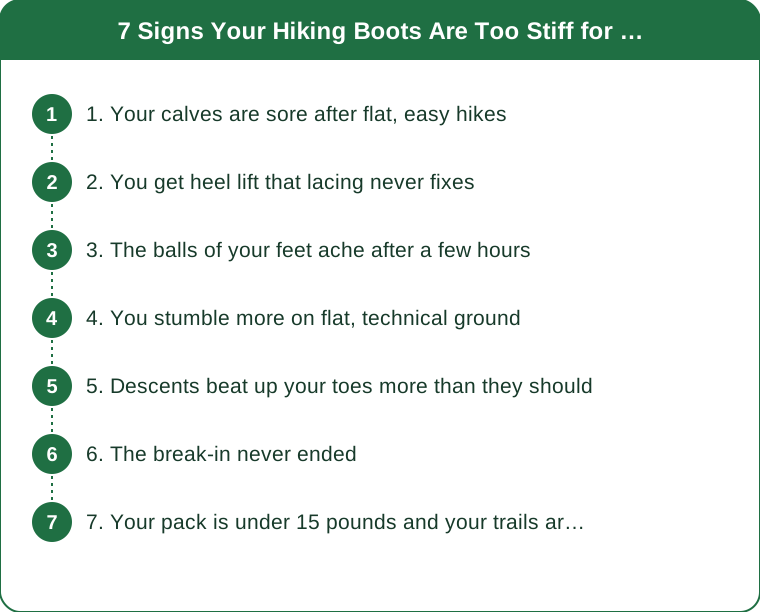
1. Your calves are sore after flat, easy hikes
A stiff boot resists the natural roll from heel to toe. On flat, forgiving ground, your calves end up doing extra work to push through that resistance every single step.
Over a six-mile flat hike, that’s thousands of repetitions of a small extra effort. The result is calf soreness that seems wildly out of proportion to the terrain — and that doesn’t show up when you walk the same distance in sneakers.
The tell: your legs feel more worked after an easy trail than after a comparable road walk. Steep terrain masks this, because on a real climb the stiff sole is doing useful work. On flat ground it’s just resistance.
2. You get heel lift that lacing never fixes
Some heel lift is a fit issue. But when a stiff sole won’t flex at the ball of the foot, your heel has to come up as the foot rolls forward — because something has to give, and if the boot won’t bend, the heel exits the heel cup.
This is the version that laughs at every lacing trick. Surgeon’s knot, heel lock, skipping eyelets — none of it helps, because the movement is being generated by the sole rather than by slack in the upper.
The tell: heel lift that’s worse on flat ground and better on steep climbs. Fit-related lift is consistent everywhere; stiffness-related lift appears exactly where you need the boot to flex most.
3. The balls of your feet ache after a few hours
When the sole won’t flex where your foot naturally wants to bend, pressure concentrates at the metatarsal heads at each step’s transition. Hours of that produces a deep ache across the forefoot, often described as walking on a plank.
It’s easy to mistake for a sizing or insole problem, and people spend real money on aftermarket footbeds chasing it.
The tell: the ache is a broad band across the ball of the foot rather than a specific hot spot. Hot spots are friction. A wide band is pressure distribution — and on easy terrain, that usually means too much sole.

4. You stumble more on flat, technical ground
Stiff boots reduce ground feel. On smooth trail that’s fine. On flat but rooty or rocky ground — the classic Northeast forest trail — you lose proprioceptive feedback about what you just stepped on, and you find out the surface was uneven a half-second later than you would have otherwise.
The tell: more trips and scuffs on flat technical trail than on genuinely steep terrain, where you’re already moving deliberately and picking each foot placement.
This one is worth taking seriously, since the whole argument for stiffer boots is safety. On the wrong terrain the trade runs the other direction.
5. Descents beat up your toes more than they should
A stiff sole doesn’t conform as your foot rolls, so on descents your foot slides forward as a unit and lands hard against the toe box. That’s the mechanism behind bruised toenails on hikes that weren’t especially long or steep.
A more flexible boot lets the forefoot spread and grip on the way down, which distributes the deceleration across the whole foot instead of loading it all into the front.
The tell: toe pain on moderate descents, in boots that fit correctly with a thumb’s width of room. If the fit checks out and descents still punish your toes, look at flex.
6. The break-in never ended
A properly matched boot feels reasonable within a few outings. Genuinely stiff mountaineering-oriented boots take much longer — sometimes 30 to 50 miles — and if you’re only hiking easy trail, you may never put in the mileage or the load needed to soften them.
The tell: you’re 40 miles in and they still feel like boards. That isn’t a break-in failure; it’s a boot asking for terrain and pack weight you aren’t giving it.
Myth vs Fact: Myth — all hiking boots need a long, painful break-in. Fact — flexible hiking boots and trail runners need almost none. The long break-in is a property of stiff-shanked boots specifically, and it’s a cost you should only accept if you actually need what that shank provides.
7. Your pack is under 15 pounds and your trails are maintained
This is less a symptom than the underlying diagnosis, and it’s worth checking before you troubleshoot anything else.
Stiff soles exist to do two things: distribute load over sharp, uneven rock, and provide an edging platform on steep or technical ground. Both matter enormously when you’re carrying 35 pounds across talus. Neither does much on a groomed 8-mile loop with a daypack.
Rough matching guide:
- Maintained trail, pack under 15 lb: trail runner or flexible low/mid boot
- Mixed trail with rocky sections, 15-25 lb: moderate-flex backpacking boot
- Off-trail, talus, scree, 25 lb+: stiff-shanked backpacking boot
- Technical alpine, crampon compatibility: full mountaineering boot
Most people who describe boot problems are one full category too stiff for what they actually do. Buying for the trip you might take someday means being uncomfortable on all the trips you actually take.
General information, not medical advice — persistent foot pain that doesn’t resolve when you change footwear is worth a professional look.
TL;DR:
- Stiffness is a terrain-and-load tool, not a general upgrade — more isn’t safer on easy ground.
- Calf soreness on flat hikes, unfixable heel lift, and a broad forefoot ache are the three clearest signs.
- Stiff boots reduce ground feel, which can increase stumbles on flat technical trail.
- Match to reality: under 15 lb on maintained trail wants a flexible boot or trail runner.
Before you replace anything, take your current boots on a genuinely steep, rocky hike. If the problems disappear, the boots are fine and the terrain was the mismatch — and you now know exactly what to buy for the hikes you actually do most weekends.
Keep Reading
This article is for general informational and styling purposes only. Fit, sizing, and product availability may vary.