7 Signs Your Hiking Boots Are Done - and Not Worth Resoling
Quick Answer: Tread wear alone is not a reason to replace boots - that is exactly what resoling fixes. The failures that end a boot are midsole compression, upper delamination, a broken shank, and a collapsed heel counter, because none of those are repairable at a sensible price. Check the midsole and the heel counter first; if both are sound and the boot has a stitched or cemented-but-resoleable construction, a resole is usually the better call.
Most people replace boots too early for the wrong reason and too late for the right one.

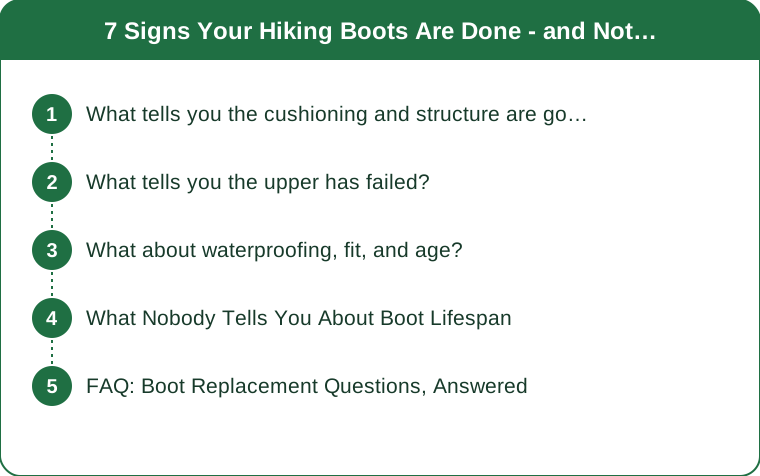
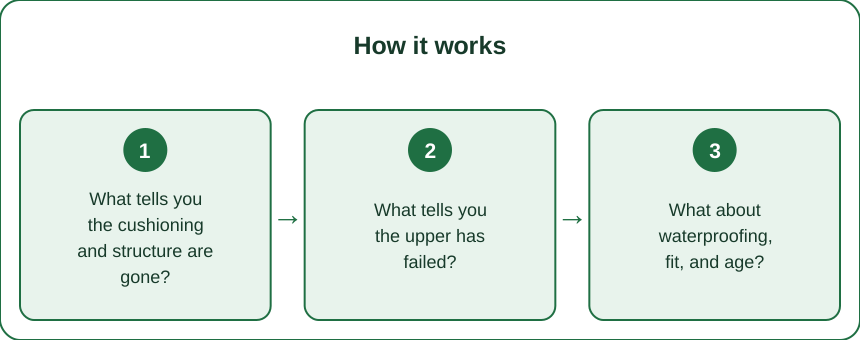
What tells you the cushioning and structure are gone?
1. The midsole is compressed and creased
This is the most important sign and the one people miss, because it happens invisibly. The midsole - the layer between your foot and the outsole - is usually EVA foam, and foam does not last forever. It compresses permanently with use, and once it is compressed it stops absorbing impact.
How to check: look at the midsole from the side under good light. Horizontal wrinkles or creases running along it, particularly in the forefoot and heel, mean the foam has collapsed. Press it firmly with a thumb - healthy foam rebounds, dead foam stays dented.
The symptom that sends people looking is foot fatigue and sore soles on descents from a boot that used to be comfortable. That is compressed midsole, and no amount of new tread fixes it. A resole replaces the outsole, not the midsole, on most repairs.
Rough lifespan: 500 to 1000 kilometres for EVA, considerably longer for polyurethane midsoles, which are common in heavier mountaineering boots and are one reason those boots justify resoling.
2. The shank has softened or broken
The shank is the stiffening element in the sole that stops the boot twisting. Test it by holding heel and toe and trying to wring the boot like a towel. A boot in good condition resists strongly. If it twists easily and it did not when new, the shank has failed - and that is a structural failure that turns a supportive boot into an expensive flexible shoe. On rocky ground it is also a genuine ankle risk.
This one is effectively unrepairable. When the shank is gone, so is the boot.
What tells you the upper has failed?
3. The upper is separating from the sole
Run a fingernail along the join between the upper and the sole unit all the way around. Any section where it lifts or opens is delamination. A small separation at the toe can sometimes be re-glued and bought another season; separation along the side or heel means the bonding surface has degraded and a repair will not hold.
This matters for resoling specifically: a cobbler needs a sound upper to bond a new sole to. A delaminating upper is the most common reason a resole gets declined.
4. The heel counter has collapsed
The heel counter is the stiff cup at the back that holds your heel in place. Squeeze it from both sides. It should resist firmly. If it folds inward easily, it is done - and a collapsed heel counter is why an old boot lets your heel lift and blister no matter how you lace it.
Some cobblers can replace one; most cannot economically. Treat this as a strong signal toward replacement.
5. Creasing has cracked through the leather or fabric
Deep flex creases across the forefoot are normal. Cracks within those creases are not - they are a waterproofing failure and a structural weak point that will spread. On leather, a crack that has gone through the grain will not be reconditioned back to soundness. On synthetic uppers, cracking usually means the material has hardened with age and heat, which is irreversible.

What about waterproofing, fit, and age?
6. It leaks and re-treating does not help
A boot that wets out in light rain after a proper clean and re-treatment has either a failed membrane or a failed seam tape. Neither is repairable in practice.
Before concluding this, though, do the simple things: boots frequently leak because they are filthy. Dirt in the fabric wicks water straight through a membrane that is technically fine. Clean properly, dry properly, re-treat, and test again before writing them off. This is the failure that gets misdiagnosed most often.
7. The fit has changed and not in a good way
Boots mould to your feet, which is good, up to the point where they have moulded past the shape that holds you securely. Signs you have passed it: heel lift that lacing no longer solves, toes hitting the front on descents that used to be fine, or a general sense that the boot has gone sloppy.
Some of this is your feet rather than the boot - feet lengthen and widen over years, and it is worth remeasuring before assuming the boots are at fault. But a boot that has stretched to sloppiness is finished as a load-carrying boot, even if it still works for gentle walks.
So when is resoling actually worth it? When the tread is worn but the midsole is firm, the shank is solid, the upper is intact and bonded, and the heel counter holds. That combination usually appears on well-made leather boots with polyurethane midsoles, and on those a resole at a fraction of replacement cost is excellent value - some boots take three or four resoles across a decade.
It is almost never worth it on lightweight synthetic boots with EVA midsoles, because the midsole reaches end of life at about the same time as the tread, and there is nothing sound left to build on.
What Nobody Tells You About Boot Lifespan
Storage kills more boots than trails do. Polyurethane midsoles degrade through hydrolysis - a slow chemical breakdown accelerated by heat, damp, and time - whether or not you wear them. Boots stored in a hot loft or a damp garage can crumble on their first walk after a few years of sitting. Cool, dry, and used occasionally is the right regime.
Mileage numbers are nearly useless as a guide. The commonly quoted 800 to 1000 kilometres assumes a particular weight, terrain, and gait. A 60kg walker on soft trails will double it; a heavy pack on rock and scree can halve it. Inspect the boot rather than counting kilometres.
Both boots do not wear out together. Gait asymmetry is normal, and one boot routinely shows notably more wear. Judge the pair by the worse one, and treat a large difference as a prompt to look at your gait or your insoles.
Rotating two pairs extends both by more than half. Midsole foam recovers some of its rebound over 24 to 48 hours of rest. Alternating pairs on consecutive days genuinely extends total lifespan - the effect is well established in running shoes and applies here too.
A worn boot changes your gait before it hurts your feet. Uneven outsole wear tilts your foot, and the compensation shows up as knee, hip, or lower back complaints. When something up the chain starts aching for no obvious reason, checking the boots is a reasonable early step.
Retiring boots to lighter duty is the best value move on this list. A boot that is finished for multi-day loaded walking is often perfectly good for dog walks, gardening, and short local trails for years more. Replacing does not have to mean discarding.
FAQ: Boot Replacement Questions, Answered
How much should a resole cost relative to new boots?
Typically a quarter to a half of the price of a comparable new pair, depending on whether the midsole is also replaced. If a quote lands above half, the calculation rarely favours repair unless the boots are broken in and irreplaceable.
My boots are only two years old. Can they really be finished?
Easily, if the mileage is high or the storage was poor. Conversely, boots can also be finished at three years having barely been worn, if they sat in a hot loft. Age alone tells you very little - the inspection tells you everything.
Is it dangerous to keep hiking on worn boots?
On easy terrain, mostly it is uncomfortable rather than dangerous. On steep, wet, or rocky ground it is a real issue: worn tread on wet rock is a slip risk, and a failed shank or heel counter genuinely raises ankle injury risk. Match the boot’s remaining condition to the terrain.
Should I replace both boots if only one has failed?
Yes. Different amounts of midsole compression in each boot creates a leg-length and support asymmetry that causes its own problems. Boots are a pair for a reason.
TL;DR:
- Worn tread is a resole job, not a replacement trigger. The failures that actually end a boot are structural.
- Check four things: midsole compression (creases, no rebound), shank stiffness (does it twist?), upper delamination, and heel counter collapse.
- Persistent leaking after a proper clean and re-treat means a failed membrane, which is not repairable.
- Resoling is good value on leather boots with polyurethane midsoles and poor value on lightweight synthetics with EVA.
- Storage degrades boots even unworn. Cool and dry, and inspect before the first big walk of the season.
Before you buy, spend two minutes with a thumb on the midsole. It answers the question faster than the tread does.
Keep Reading
This article is for general informational and styling purposes only. Fit, sizing, and product availability may vary.