7 Signs You Bought the Wrong Hiking Boot Width (Not Just the Wrong Size)
Quick Answer: Numbness across the top of your foot, black toenails despite correct length, and pressure points on the sides rather than the toe box all point to a width problem, not a length problem. Most hikers try 2-3 length sizes before ever testing a wide or narrow version of the same boot.
You sized up, sized down, tried different socks — and your feet still hurt on every hike. Length isn’t the only variable, and for a lot of hikers, it was never the actual problem.
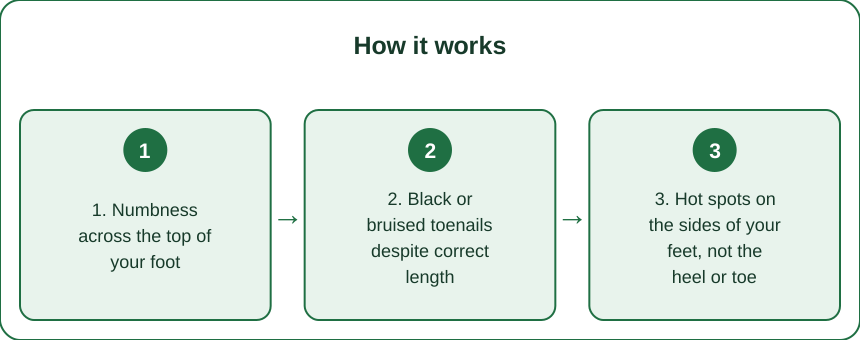
1. Numbness across the top of your foot
A boot too narrow compresses the top of your foot against the laces, which can numb nerves running across the forefoot. This is distinct from toe-box crowding, and it’s a classic width-specific complaint.
2. Black or bruised toenails despite correct length
If your toes have enough room lengthwise (you can wiggle them, a thumb’s width of space at the front) but nails still bruise, sideways pressure from a too-narrow fit is pushing toes against each other and against the boot’s sides.
3. Hot spots on the sides of your feet, not the heel or toe
Heel and toe pain often signal a length issue. Pain specifically along the sides — near the pinky toe or the inner arch — points to width.

4. Your foot slides side to side inside the boot
A boot too wide lets your foot shift laterally with every step on uneven terrain, which creates friction and instability that no amount of tighter lacing fully solves.
5. You need to loosen laces significantly to relieve pain
If comfort only comes from laces so loose your heel lifts with every step, the boot is likely too narrow for your foot and you’re compensating rather than actually fixing fit.
6. Foot shape mismatch and brand-to-brand differences
Your foot shape doesn’t match the boot’s shape at rest
Take the insole out and stand on it. If your foot visibly overhangs the sides or leaves significant empty space, that’s a direct width mismatch independent of length.
Different brands feel dramatically different at the ‘same’ size
Boot width isn’t standardized across brands the way length sizing roughly is. If one brand’s size 9 fits fine and another’s size 9 is consistently painful in the same way, that brand likely runs narrow or wide relative to your foot.
FAQ: Hiking Boot Width Questions, Answered
How do I find out my actual foot width?
Many outdoor retailers offer a Brannock-style width measurement in-store — this measures both length and width simultaneously and is more reliable than guessing from past shoe sizes.
Do wide-width hiking boots cost more?
Sometimes slightly, but the cost difference is minor compared to the cost (in blisters and ruined hikes) of hiking in the wrong width for years.
Can insoles fix a width problem?
Insoles can address minor volume issues but won’t meaningfully change actual width mismatch — a boot fundamentally too narrow or too wide needs a different boot, not a different insole.
TL;DR:
- Numbness on top of the foot and side pressure point to width, not length
- Black toenails at the correct length are usually a width symptom, not a sizing-up signal
- A visible foot overhang on the insole confirms a width mismatch directly
- Different brands run different widths at the ‘same’ size — always test, don’t assume
Keep Reading
This article is for general informational and styling purposes only. Fit, sizing, and product availability may vary.