7 Signs Your Hiking Boots Don't Actually Fit (Even If They Felt Fine in the Store)
Quick Answer: Common signs of poorly fitted hiking boots include toe pressure on downhills, heel slipping on climbs, numbness after an hour, hot spots in the same location every hike, and lacing that never feels quite right — a store fit test rarely catches these because it doesn’t replicate hours of trail movement.
They felt fine walking around the store for five minutes. Three miles into a downhill stretch, your toes are telling a very different story.

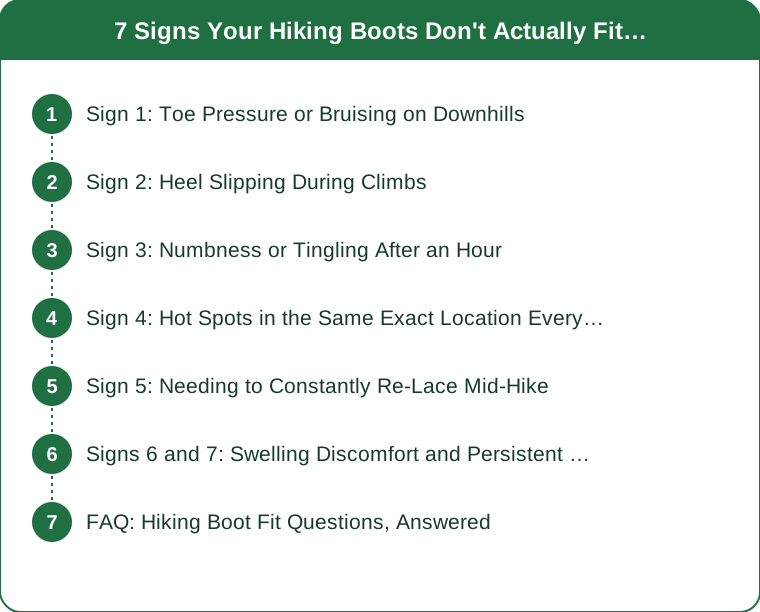
Sign 1: Toe Pressure or Bruising on Downhills
If your toes jam into the front of the boot on descents, there isn’t enough length or volume in the toe box, even if the boot felt fine on flat store floors — downhill movement pushes your foot forward in a way flat walking never reveals.
Sign 2: Heel Slipping During Climbs
A heel that lifts noticeably out of the boot while climbing means the boot’s volume is too large for your heel, even if the overall length is correct — this often causes blisters that store try-ons never surface.
Sign 3: Numbness or Tingling After an Hour
Numbness, especially across the top of the foot, often points to lacing that’s too tight in the wrong zone, or a boot shape that doesn’t match your foot’s volume — this rarely shows up until swelling from hours of walking sets in.

Sign 4: Hot Spots in the Same Exact Location Every Hike
A recurring hot spot in one specific place (often the outer pinky toe or Achilles) means there’s a persistent friction point specific to your foot shape, not a break-in issue that will resolve with more wear.
Sign 5: Needing to Constantly Re-Lace Mid-Hike
If you’re stopping repeatedly to adjust laces, the boot’s structure isn’t holding your foot securely on its own, which suggests a fit or shape mismatch rather than a lacing technique problem.
Signs 6 and 7: Swelling Discomfort and Persistent Break-In Pain
Sign 6: Your Foot Feels Different by the End of a Long Hike
Feet naturally swell during long hikes, and a boot with no room to accommodate that swelling becomes painfully tight by mile 8, even though it felt perfect at the trailhead that morning.
Sign 7: Persistent Discomfort Even After a Proper Break-In Period
Genuine break-in issues (minor stiffness, slight rubbing that fades) typically resolve within a few short hikes — discomfort that persists past that point usually signals an actual fit issue, not a boot that just needs more time.
FAQ: Hiking Boot Fit Questions, Answered
How much extra toe room should hiking boots have?
A thumb’s width (roughly half an inch) between your longest toe and the front of the boot is the standard guideline, allowing room for downhill foot movement and swelling.
Should I try boots on with the socks I’ll actually hike in?
Yes — sock thickness meaningfully changes fit, so trying boots with your actual hiking socks (not thin store socks) gives a far more accurate sense of true fit.
Is it normal for boots to need a break-in period at all?
Some mild break-in is normal, especially for leather boots, but it should involve minor stiffness fading, not persistent pain points that don’t improve after a few hikes.
TL;DR:
- A comfortable store fit doesn’t guarantee a good trail fit — hours of movement reveal different problems
- Toe pressure on downhills and heel slip on climbs are two of the most common warning signs
- Recurring hot spots in the same spot signal a real fit issue, not a break-in problem
- Try boots on with your actual hiking socks and allow thumb’s-width toe room
Before your next big hike, pay attention to which of these seven signs shows up — it’ll tell you whether it’s time for a different boot.
Keep Reading
This article is for general informational and styling purposes only. Fit, sizing, and product availability may vary.