7 Lacing Fixes for the Boot Problems You Actually Have
Quick Answer: Before you buy new boots or another insole, try lacing. Heel slip, toe bang on descents, top-of-foot pressure, and forefoot squeeze all have specific lacing fixes - surgeon knot, heel lock, window lacing, and skip lacing among them. The fixes below are matched to the symptom, and most take under a minute at the trailhead. A boot that fits the shape of your foot but not the volume is almost always a lacing problem, not a sizing one.
Seven fixes, each tied to one complaint. Find your complaint, use that one, and ignore the rest.

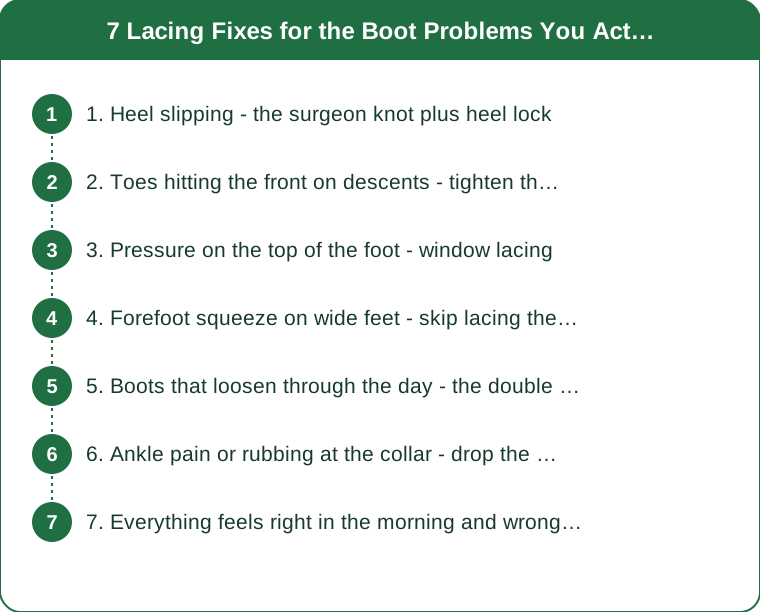
1. Heel slipping - the surgeon knot plus heel lock
The symptom: your heel lifts on climbs, and you get a blister on the back of the heel by mile four.
The fix is two techniques stacked. First, a surgeon knot at the ankle flex point: at the eyelet where your foot bends, wrap the laces around each other twice instead of once before continuing up. That double wrap creates friction and locks the tension of the lower foot in place so it cannot migrate upward when you walk.
Then a heel lock using the top two eyelets or hooks: run each lace straight up to the top hook on its own side to create a vertical loop, then cross each lace through the opposite loop before tying. This pulls the ankle collar backward against your heel.
Why this works when a tighter overall lace does not. Simply cranking every eyelet tight crushes the forefoot without adding heel hold. The surgeon knot lets you keep the forefoot comfortable and the ankle firm as two separate zones, which is the entire trick. Nearly every heel slip complaint responds to this within one hike.
2. Toes hitting the front on descents - tighten the ankle, not the toes
The symptom: bruised toenails, or that specific ache in the front of the foot after a long downhill.
The instinct is wrong. People tighten the forefoot to stop the foot sliding forward, which does nothing - the foot slides at the heel, not at the toes.
The fix: surgeon knot at the flex point, then genuinely firm through the ankle and heel lock at the top, and leave the forefoot section noticeably looser than you would for flat ground. Your foot swells on descent and your toes need room to splay.
Re-lace before the descent, not at the car. This is the habit that separates people who lose toenails from people who do not - stop at the top, tighten the ankle section, and loosen the forefoot by one eyelet. It takes 40 seconds and it is the single highest-return boot habit there is. Downhill loading on the forefoot is dramatically higher than on the flat, and a boot laced for the climb is the wrong boot for the descent.
3. Pressure on the top of the foot - window lacing
The symptom: a hot spot or numbness across the top of the foot, often right where the tongue creases, sometimes with tingling in the toes.
The fix, called window lacing or box lacing: at the eyelet pair where the pressure is, run each lace straight up its own side to the next eyelet instead of crossing over. Then resume normal crossing above it. You have created a window - a gap in the lacing over the sore spot - and the tension routes around it rather than through it.
Why it matters more than it sounds. The area across the top of the foot carries a nerve close to the surface, and sustained lace pressure there is a genuine cause of numbness and tingling rather than mere discomfort. If you get pins and needles in your toes after an hour, this is usually the cause and this is usually the fix.
High arches make this far more likely, because a high instep meets the lacing sooner. If you have high arches and every boot hurts across the top, window lacing is the first thing to try - before insoles, before wider boots.

4. Forefoot squeeze on wide feet - skip lacing the lower eyelets
The symptom: your toes feel compressed side to side, and the discomfort is worst in the first third of the boot.
The fix: skip the lowest one or two eyelet pairs entirely and start lacing higher up. This lets the forefoot open to its natural width while the mid and upper boot still hold the foot in place.
It sounds like it should make the boot sloppy, and it does not - almost all of the security in a hiking boot comes from the ankle and instep, not the toe box. The lower eyelets contribute far less hold than people assume.
Combine it with a surgeon knot at the instep so the loose forefoot section cannot creep tighter as you walk. For feet that are wide at the ball but normal at the heel - one of the most common shapes and one the boot industry serves badly - this combination turns an almost-right boot into a workable one.
5. Boots that loosen through the day - the double surgeon knot
The symptom: you lace up firm, and by lunchtime everything has slackened and your heel is moving again.
What is happening: the tension is migrating. Laces slide through eyelets as you flex, and the tension in the tight zones bleeds off into the loose ones until everything averages out.
The fix: add a second surgeon knot. Use one at the instep flex point as usual, and a second one two eyelets higher. You have now divided the boot into three independently tensioned zones, and tension cannot travel between them.
Also check the laces themselves. Round, slippery synthetic laces migrate far more than flat, textured ones. Replacing round laces with flat ones fixes a surprising number of loosening complaints for the price of a coffee, and it is worth trying before you spend an evening learning knots.
6. Ankle pain or rubbing at the collar - drop the top hooks
The symptom: rubbing at the ankle bone, or a boot that feels like it is fighting your ankle on uneven ground.
The fix: you do not have to use every hook. Lacing to the second-from-top hook and skipping the last one reduces collar pressure substantially while keeping most of the heel hold, especially if you use a heel lock at the hook you do finish on.
When to do the opposite. On steep, loaded descents or genuinely rough ground, use all the hooks and lace firm - that is what they are for. The point is that lacing height should change with terrain, and most people lace their boots identically for a flat forest path and a scree descent.
On the ankle bone specifically: if the rub is on the bone itself rather than the soft tissue, that is often a boot collar height mismatch and lacing will only partly help. A thicker sock or a small pad taped over the spot for one hike will tell you whether it is fixable or whether the boot is simply the wrong height for you.
7. Everything feels right in the morning and wrong by afternoon - relace on schedule
The symptom: nothing is specifically wrong; the boots just stop being comfortable partway through.
Your feet change through a hike. They swell - commonly by half a size or more over a long day, more in heat, more at altitude, more with a heavy pack. A boot laced perfectly for cool, unswollen morning feet is measurably too tight by hour four.
The habit that fixes it: relace three times on any hike over about three hours.
- At the trailhead, moderately firm
- At the top of the main climb, loosening the forefoot and tightening the ankle for the descent
- Whenever you stop for food, taking 30 seconds to reassess rather than assuming the morning setting still applies
What nobody tells you: experienced hikers relace constantly and it looks like fussiness. It is not - it is the recognition that the foot in the boot at hour six is not the foot that went in at hour zero. Most blister prevention is exactly this and nothing more sophisticated.
TL;DR:
- Surgeon knot at the flex point is the foundation - it splits the boot into independently tensioned zones
- Heel slip and descent toe bang both get fixed at the ankle, never at the toes
- Window lacing relieves top-of-foot pressure and the numbness that comes with high arches
- Skip the lowest eyelets for wide forefeet; drop the top hook for ankle collar rubbing
- Relace at the trailhead, at the top of the climb, and at every food stop - feet swell half a size on a long day
Try the surgeon knot and heel lock on your next hike before you spend anything. Most of what gets diagnosed as the wrong boot turns out to be the right boot laced as one undifferentiated tube.
Keep Reading
This article is for general informational and styling purposes only. Fit, sizing, and product availability may vary.