7 Hiking Boot Problems That Only Show Up on the Way Down
Quick Answer: Descending shifts your entire body weight forward into the toe box, adds impact roughly two to three times body weight per step, and puts your foot at an angle it never reaches while climbing. The seven problems below — toe bang, heel float reversal, lace pressure, arch collapse, ankle roll, hot spots at the ball, and calf-shaft rub — are almost all fixable with lacing, sizing or sock changes rather than new boots.
If your boots feel great going up and terrible coming down, the boots are not the whole story. The descent is a different test.
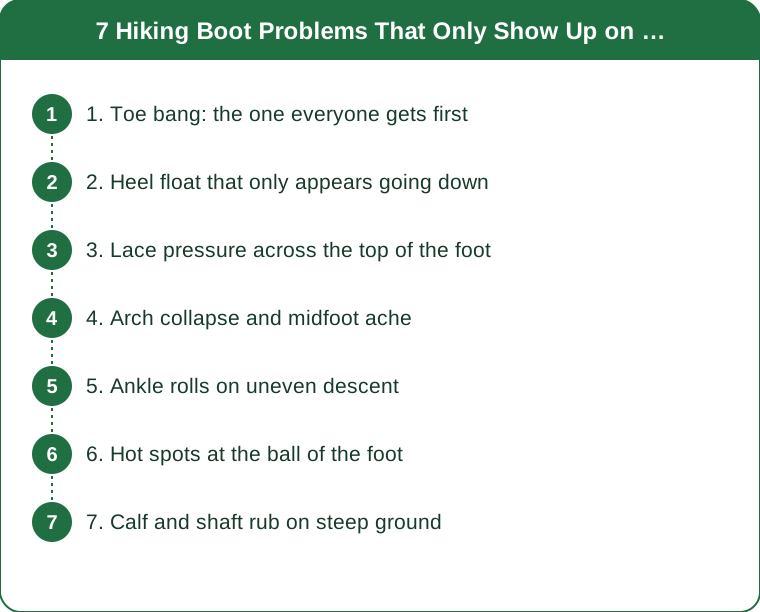
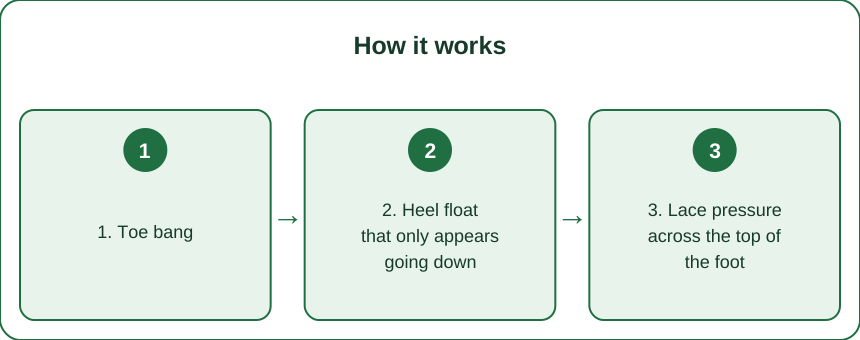
1. Toe bang: the one everyone gets first
Your foot slides forward inside the boot on every downhill step and your toes hit the front. Over several thousand steps, this produces bruised nails, blackened toenails and, eventually, nails that come off entirely.
Root causes, in order of frequency: boots half a size too small, laces not locked at the ankle, and downhill technique that lands heavy on the heel with a straight leg.
The fixes: size up by about half a size from your street shoe and confirm with the heel-back test — slide your foot forward until your toes touch the front, and you should fit one finger behind the heel. Then use a surgeon’s knot at the instep before the ankle hooks, which locks the forefoot and prevents the slide. Trim toenails short and square before every long hike.
And the technique piece: shorter steps with a slightly bent knee absorb impact through the leg rather than driving the foot into the toe box.
2. Heel float that only appears going down
The reverse of what most people expect. A heel that sits snug on flat ground can lift on descent because the ankle flexes into a different position and the boot’s heel counter no longer conforms.
How to tell: blisters on the back of the heel that appear only after downhill sections, or a distinct sensation of the heel lifting on steep ground.
The fixes: the same surgeon’s knot at the instep also helps here, and adding a heel lock — wrapping the lace around the top hooks in a figure of eight before tying — pulls the heel back into the counter specifically.
If lacing does not solve it: a thicker insole takes up volume and raises the heel into a tighter part of the counter. A heel-grip pad is the cheaper first attempt and works surprisingly often.
3. Lace pressure across the top of the foot
Descending requires tighter lacing than ascending, and tighter lacing across the instep is where nerve compression happens. The result is numbness across the top of the foot or into the toes, usually appearing 20 to 40 minutes into a sustained descent.
Why it happens on the way down specifically: you tighten the laces at the top of the climb, then your feet swell over the course of the day, then the descent puts forward pressure into an already-tight instep.
The fixes: window lacing — skipping the eyelet pair directly over the pressure point and lacing straight across instead — relieves a specific hot spot without loosening the whole boot. Alternatively, tighten firmly at the ankle and above, and leave the instep looser.
Do not simply loosen everything, which reintroduces problem one. The goal is loose at the instep, locked at the ankle.
4. Arch collapse and midfoot ache
Several hours of descending fatigues the muscles supporting the arch, and a tired arch flattens. The result is aching through the midfoot and sometimes into the heel, appearing late in a hike rather than early.
Why descending is worse: eccentric loading — muscles lengthening under load — is far more fatiguing than concentric work, and the entire descent is eccentric.
The fixes: a supportive aftermarket insole makes more difference than most boot upgrades, and stock insoles in even expensive boots are usually minimal. Beyond that, calf and foot strength work between hikes genuinely reduces this — heel raises and toe-yoga style exercises three times a week over a few weeks show up on the trail.
A useful mid-hike intervention: stop, take the boots off for five minutes, and let the arch unload. It resets more than it sounds like it should.
5. Ankle rolls on uneven descent
Descending on loose or rocky ground with a fatigued lower leg is when ankles roll. Boot height helps less than people assume — the evidence for high-cut boots preventing ankle injury is genuinely mixed — and proprioception and strength matter more.
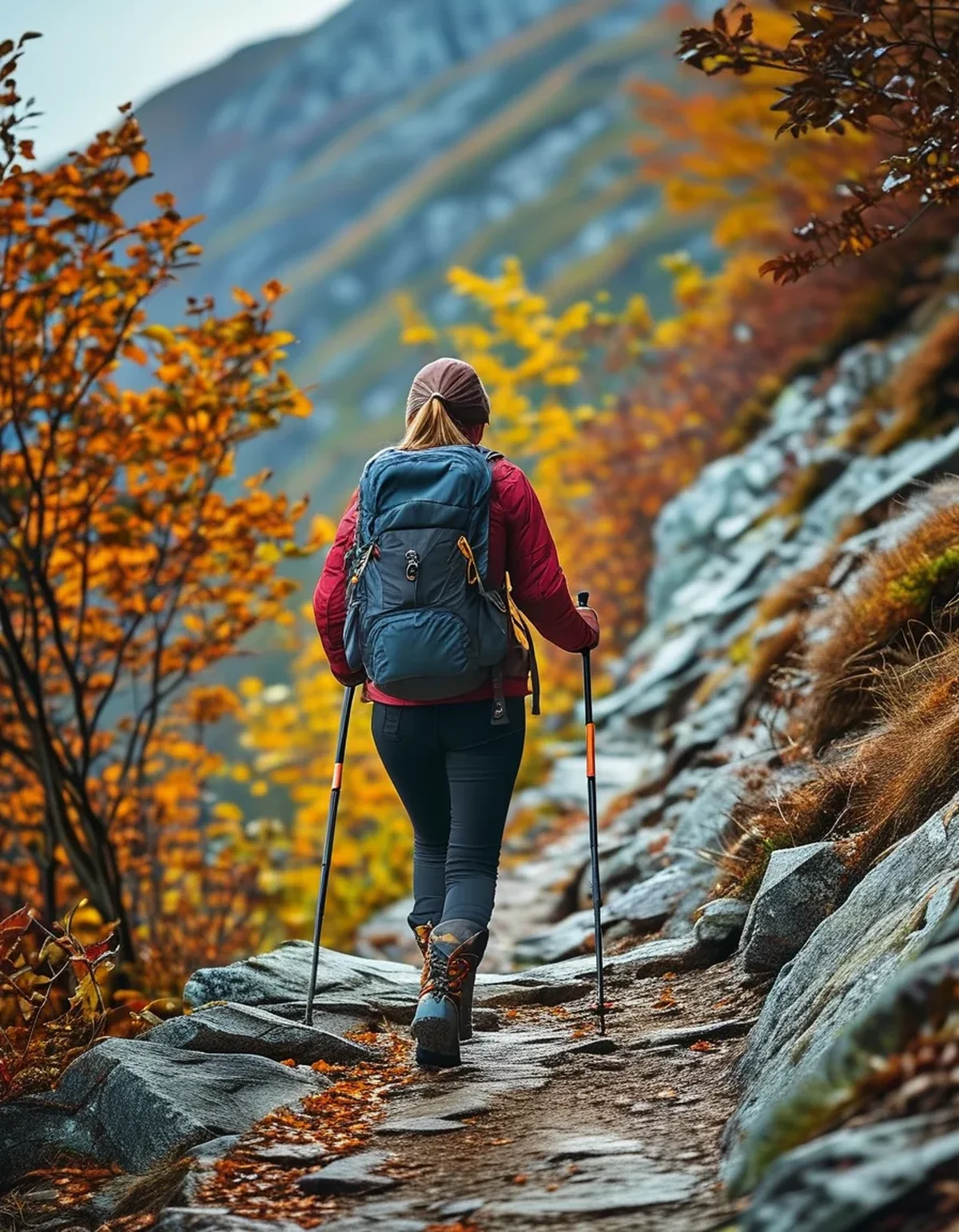
What actually reduces the risk: trekking poles, which provide two extra contact points and measurably reduce load and instability on descent. Slower cadence on technical ground. And single-leg balance work at home, which improves the reflexive stabilization that catches a roll before it becomes a sprain.
Boot-side factors that do matter: a sole with adequate lateral stiffness, and a heel that is not so aggressively elevated that it raises your center of gravity on uneven ground.
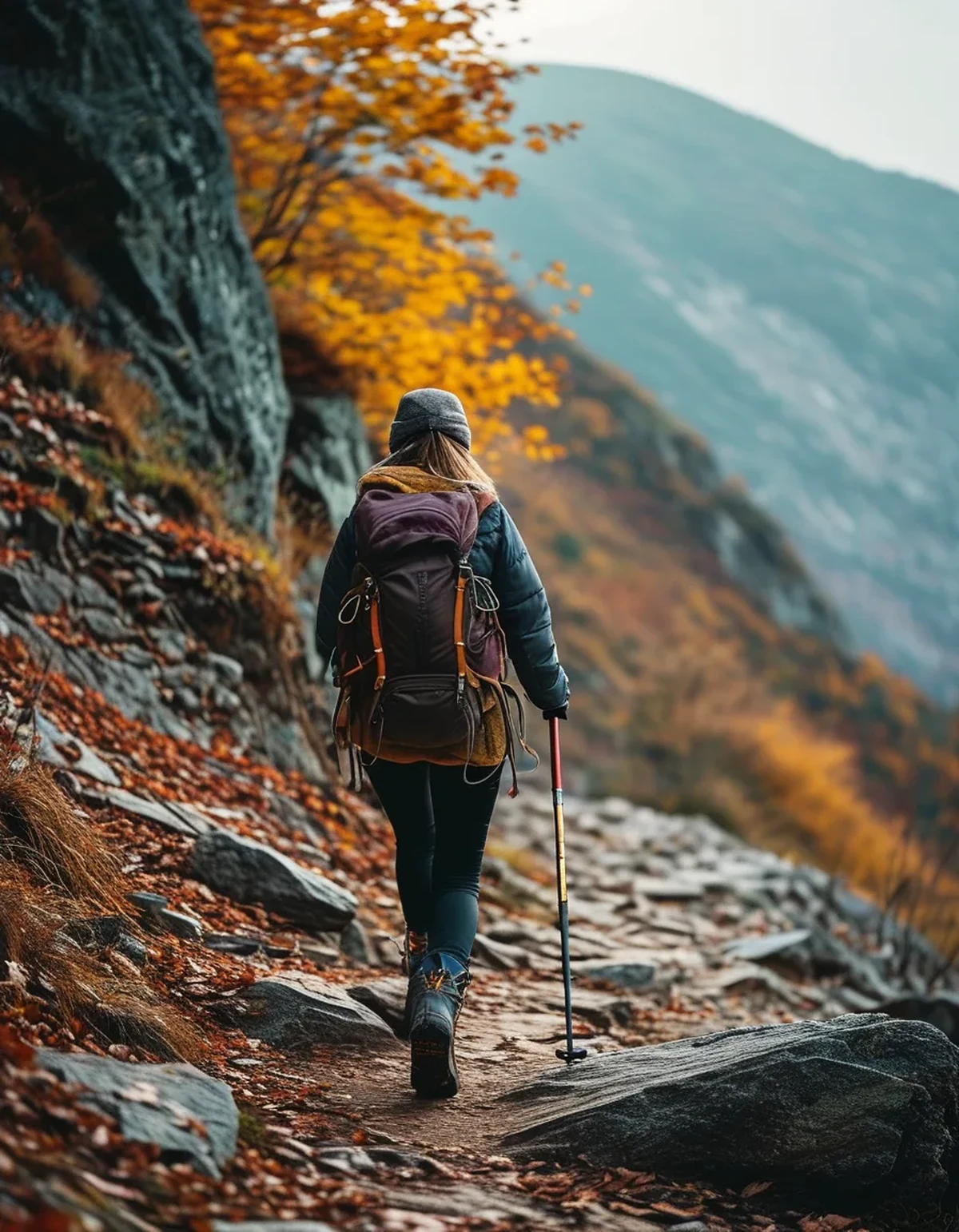
Autumn note: wet leaves over rock are among the most treacherous surfaces on any trail, and early fall descents put both together. Slow down before you think you need to.
6. Hot spots at the ball of the foot
Forward pressure on descent concentrates load at the ball of the foot, and any sock bunching, seam or insole edge in that zone becomes a hot spot and then a blister.
The three inputs: sock material, sock fit and moisture. Cotton socks hold moisture, soften skin and dramatically increase blister risk — this is the single most common gear error in hiking. Merino or synthetic hiking socks wick and hold shape.
The fixes: a properly fitted sock with no excess fabric to bunch, a liner sock under the main sock so friction happens between the two layers rather than against skin, and a mid-hike sock change on long days, which is one of the highest-return five minutes available.
When you feel a hot spot, stop immediately. Tape it before it becomes a blister. Every experienced hiker has learned this the expensive way once.
7. Calf and shaft rub on steep ground
Steep descent flexes the ankle to its limit, which pushes the top of the boot shaft into the front of the shin and the back of the calf. The result is a raw line across the shin or above the heel that only appears after sustained steep ground.
Root causes: a shaft that is too stiff or too tall for your leg, socks that are shorter than the boot shaft, or lacing that is too tight at the very top hooks.
The fixes: always wear socks taller than the boot shaft — this alone solves the majority of cases. Leave the top hooks slightly looser than the ankle hooks so the shaft can flex with you. And if a boot rubs the shin every time regardless, the flex point of that boot does not match your ankle, and no amount of adjustment will fix a structural mismatch.
FAQ: Descent Boot Questions, Answered
Should I lace differently for the descent than the ascent?
Yes, and experienced hikers routinely do. Looser at the instep and looser overall for climbing, then a stop at the summit to lock the ankle and tighten for the way down. It takes 60 seconds and prevents most of this list.
Do trekking poles really help that much?
Yes. Studies on downhill hiking with poles consistently show reduced load through the knees and reduced muscle soreness afterwards. They are the highest-value piece of gear for descent problems by a wide margin.
Are trail runners better than boots for descending?
For some people on non-technical ground, genuinely yes — lighter, more flexible, better ground feel. On loose rock, with a heavy pack, or on ground where a rolled ankle would be serious, a boot’s stiffer platform earns its weight.
How long should it take to know a new boot works on descent?
Test it on a real descent within the return window. A boot that feels perfect on a store floor and on a flat walk has told you almost nothing about the situation where boots actually fail.
TL;DR:
- Descending drives the foot forward, so size up half a size and lock the ankle with a surgeon’s knot.
- Re-lace at the top of the climb: looser at the instep, tighter at the ankle for the way down.
- Cotton socks are the most common blister cause; merino or synthetic plus a liner solves most hot spots.
- Socks taller than the boot shaft prevent shin and calf rub entirely.
- Trekking poles reduce descent load and soreness more than any boot upgrade.
- Test new boots on a real descent inside the return window, not on a flat walk.
The ascent tells you almost nothing about fit. Judge boots on the way down, where every fit failure finally shows up.
Keep Reading
This article is for general informational and styling purposes only. Fit, sizing, and product availability may vary.