7 Things to Change About Your Hiking Boots for Autumn Trail Conditions
Quick Answer: Autumn trails introduce wet leaf litter, saturated mud, early frost, and colder feet — four conditions summer boots handle poorly. Re-treat the waterproofing, check your lug depth for wear, size up your sock system, adjust your lacing for descents, and check tread on hard wet surfaces specifically. The single highest-value change is treating traction as a wet-surface problem rather than a general one — wet leaves over hardpack are among the most slippery conditions in hiking.
The boots that were perfect in August start feeling untrustworthy in October, and it isn’t gradual — one wet descent and the confidence is gone.
Seven specific things change between summer and autumn conditions. Most of them take under an hour to address.

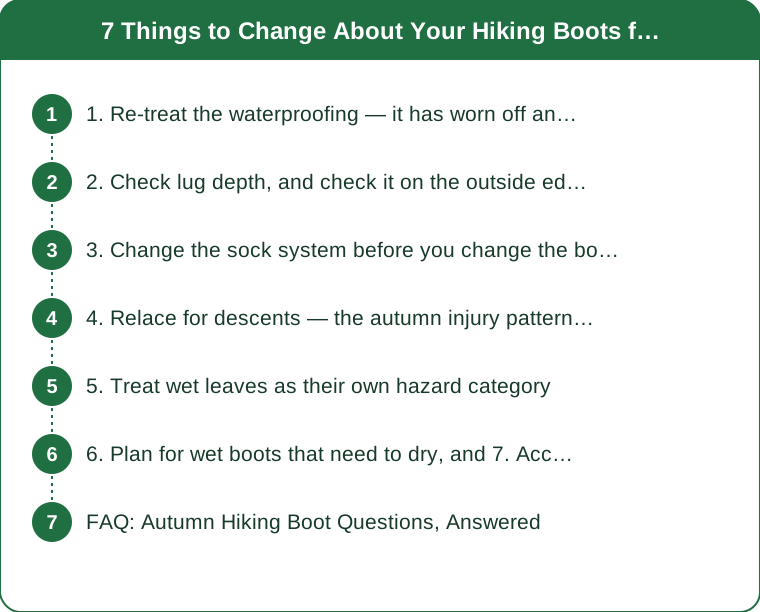
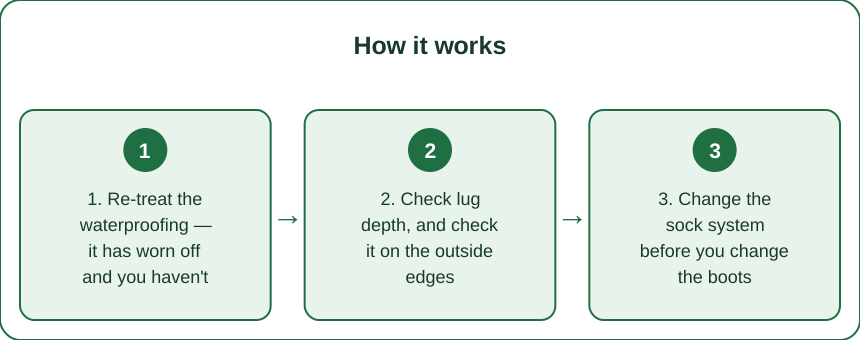
1. Re-treat the waterproofing — it has worn off and you haven’t noticed
Durable water repellent coatings degrade with abrasion, dirt, and UV, and a summer of use has taken most of yours.
The test takes ten seconds. Sprinkle water on the boot’s upper. If it beads and rolls off, the treatment is intact. If it soaks in and darkens the material, it’s gone. Most people are surprised at how thoroughly it’s gone.
A membrane boot without working DWR still ‘works’ in the sense that water doesn’t reach your foot immediately — but the upper saturates, the boot gets heavy, it takes days to dry, and breathability drops to nearly nothing, so your foot gets wet from sweat instead.
Clean before you treat. Dirt in the fabric blocks the new coating from bonding. A soft brush, lukewarm water, and a boot-specific cleaner — never detergent, which strips membranes.
Apply to a damp boot, not a dry one, for most spray and wash-in products. Check the specific product, because they differ.
Leather boots need conditioning too, and the timing matters: condition after cleaning while slightly damp, and don’t over-apply. Over-conditioned leather goes soft and loses support, which is a real and underappreciated way to ruin a good boot.
Budget 30 minutes and do it before the first wet hike, not after the hike that convinces you it was needed.
2. Check lug depth, and check it on the outside edges
Tread wear isn’t uniform, and the parts that matter most in autumn wear first.
Outsole lugs typically start at 4 to 5mm. Below about 2mm, wet-surface traction drops off sharply — and it drops off non-linearly, so the last millimeter matters more than the first two.
Look at the outside heel and the inside forefoot. These wear fastest on most gaits, and they’re the contact points during descents and side-hilling — exactly the situations where autumn conditions punish poor traction.
The heel brake is the specific feature to check. That defined edge at the back of the heel is what stops you on a wet descent. Once it’s rounded over, descending on wet leaves becomes genuinely hazardous regardless of how much tread remains elsewhere.
Rubber hardens with age even without wear. A five-year-old boot that’s been used lightly can have worse wet grip than a two-year-old boot with more visible wear, because the compound oxidizes and stiffens. Softer, stickier rubber grips wet rock; hardened rubber skates on it.
Resoling is worth it on quality boots with intact uppers — typically a fraction of replacement cost. It’s not available on most lighter boots, which are cemented rather than welted, and knowing which you own before you need to decide is useful.
3. Change the sock system before you change the boots
Most autumn foot problems are sock problems misattributed to boots.
Move from a thin summer sock to a midweight merino blend. The extra volume changes the fit — which is why boots that fit perfectly in August can feel tight in October, and why people wrongly conclude their boots have shrunk or their feet have swollen.
If the boot is now too tight, that’s a real problem, not a minor one. Compressed feet lose circulation, get colder faster, and blister more. Either the boot needs to have been bought with sock volume in mind, or you need a thinner sock and warmer conditions management.
Wool over synthetic for autumn. Merino retains warmth when damp, which synthetic does far less well — and in autumn, damp is the default state rather than the exception.
Carry a spare pair, always. A dry sock change at the halfway point of a wet hike is transformative and costs almost nothing in pack weight. This is the single highest-value autumn hiking habit.
Liner socks reduce blisters in wet conditions by taking the friction between two fabric layers instead of between sock and skin. Worth trying if you blister on wet hikes and not on dry ones — that pattern points directly at friction from damp fabric.
Never wear cotton. In autumn conditions it’s not just uncomfortable, it’s a genuine cold-injury risk on longer hikes.

4. Relace for descents — the autumn injury pattern is downhill
Wet leaves make descents the dangerous part of an autumn hike, and lacing is the free adjustment nobody makes.
Heel lift is what causes toe bang and lost control on descents. If your heel moves inside the boot, your foot slides forward on every downhill step, jamming toes into the front and reducing how precisely you can place your feet.
Use a heel lock — the surgeon’s knot. At the ankle hooks, cross the laces, wrap each lace around the opposite side twice before pulling tight, then continue lacing. This locks the heel back into the cup and takes about five seconds once you know it.
Lace looser over the forefoot, tighter at the ankle. Two-zone lacing gives toe splay room on the descent while holding the heel. Most boots have a lace hook specifically designed to separate these zones and most people lace straight through it.
Retie at the top of every significant descent. Laces loosen through a hike, and the moment you most need a locked heel is the moment they’re loosest. A 20-second stop at the summit prevents most descent foot problems.
If your toes bruise on descents regardless, the boot is likely half a size too small — a common issue because feet swell over a long day and most people fit boots at their morning size.
5. Treat wet leaves as their own hazard category
Wet leaf litter over hardpack or rock is one of the most slippery natural surfaces you’ll encounter, and it looks like a soft, forgiving trail.
The mechanism: leaves create a low-friction layer that shears against the ground beneath. Your boot grips the leaf, and the leaf slides on the surface underneath. No amount of tread solves this, because the tread is doing its job — the failure is between the leaf and the rock.
Adjust technique, not equipment. Shorter steps, more upright posture, and foot placement flat rather than heel-first. A heel strike on wet leaves is how the leg goes out from under you.
Look for what’s under the leaves. A leaf-covered root or rock is invisible and is the classic autumn ankle roll. Probe with a pole where the trail is fully covered, especially near stream crossings.
Poles become genuinely valuable in this season — two extra contact points transform descent stability on leaf litter. If you’ve never used them, autumn is the season that converts people.
Slow down on the descent specifically. Most people descend faster than they climb and autumn is the season where that habit costs the most. Adding ten minutes to a descent is cheap insurance.
6. Plan for wet boots that need to dry, and 7. Account for shorter days
6. Drying wet boots properly
Boots that get soaked in autumn often don’t fully dry before the next hike, and putting on damp boots is how a small blister becomes a real one.
Never dry boots with direct heat. Radiators, fires, and hot air vents shrink and crack leather, delaminate adhesives, and damage membranes. This is the most common way people destroy good boots.
Remove the insoles and open the boot fully. The insole holds most of the moisture and dries separately in a fraction of the time.
Newspaper or a boot dryer at low temperature. Stuff loosely, change the paper after two hours, and allow 24 to 48 hours for a properly soaked boot. Air movement matters more than warmth — a fan pointed at open boots beats a warm cupboard.
Two pairs in rotation solves this entirely for anyone hiking more than once a week in autumn, and is a better use of money than an expensive single pair.
7. Shorter days change the gear calculation
Sunset arrives progressively earlier, and an autumn hike that starts at the same time as a summer one finishes in different light.
A headlamp goes in the pack from September onward, permanently. Not because you plan to hike in the dark, but because an ankle roll on wet leaves at 4pm can mean finishing at 6pm.
Cold feet are worse in low light because temperatures drop fast after sunset, and a boot that was adequate at 2pm can be inadequate at 5pm. Factor the return leg’s conditions, not the departure’s.
Turn around earlier than feels necessary. The autumn margin is thinner than the summer one in every direction — light, temperature, and traction all degrade simultaneously as the day ends.
FAQ: Autumn Hiking Boot Questions, Answered
Do I need waterproof boots for autumn hiking?
For genuinely wet conditions, yes — a membrane boot keeps feet dry through wet grass, puddles, and light stream crossings. In milder autumn conditions, non-waterproof trail shoes that drain and dry quickly can be the better choice, particularly if you’ll be crossing water where the boot will flood anyway.
How do I know when to replace rather than resole?
Check the upper and the midsole. If the upper is intact and the midsole still has rebound, resoling makes sense on a welted boot. If the midsole is compressed and creased, the boot’s cushioning and support are already gone and a new sole won’t restore them.
Are gaiters worth it in autumn?
Low gaiters are genuinely useful in wet leaf litter and mud — they keep debris and water out of the boot top, which is the main entry point when the ground is saturated. They’re inexpensive and take up almost no pack space.
My feet get cold even in good boots. What else can I do?
Check for over-tight lacing first, which restricts circulation more than most people realize. Then look at sock thickness relative to boot volume, whether your insole is a thin stock one, and whether you’re staying fueled — cold extremities on a long hike are often an energy problem rather than an insulation one.
Should I buy autumn-specific boots?
Usually not. A well-maintained three-season boot with good tread and working DWR handles autumn fine. The exception is if you regularly hike in early snow or genuine cold, where an insulated boot becomes worth owning separately.
TL;DR: Autumn doesn’t need different boots. It needs seven specific adjustments to the ones you have.
- Test and re-treat the DWR. Water should bead; if it soaks in, the coating is gone and breathability with it.
- Check lug depth below 2mm and the heel brake specifically — that edge is what stops you on wet descents.
- Move to a midweight merino sock and carry a spare pair. Most autumn foot problems are sock problems.
- Lace with a heel lock and retie at the top of every descent. Downhill is where autumn injuries happen.
- Treat wet leaves as their own hazard — shorter steps, flat foot placement, and poles.
- Never dry boots with direct heat, and allow 24 to 48 hours with insoles removed.
- Headlamp in the pack from September, and turn around earlier than feels necessary.
Do the water-bead test tonight. It takes ten seconds and it’s the one that changes the most about your next wet hike.
Keep Reading
This article is for general informational and styling purposes only. Fit, sizing, and product availability may vary.